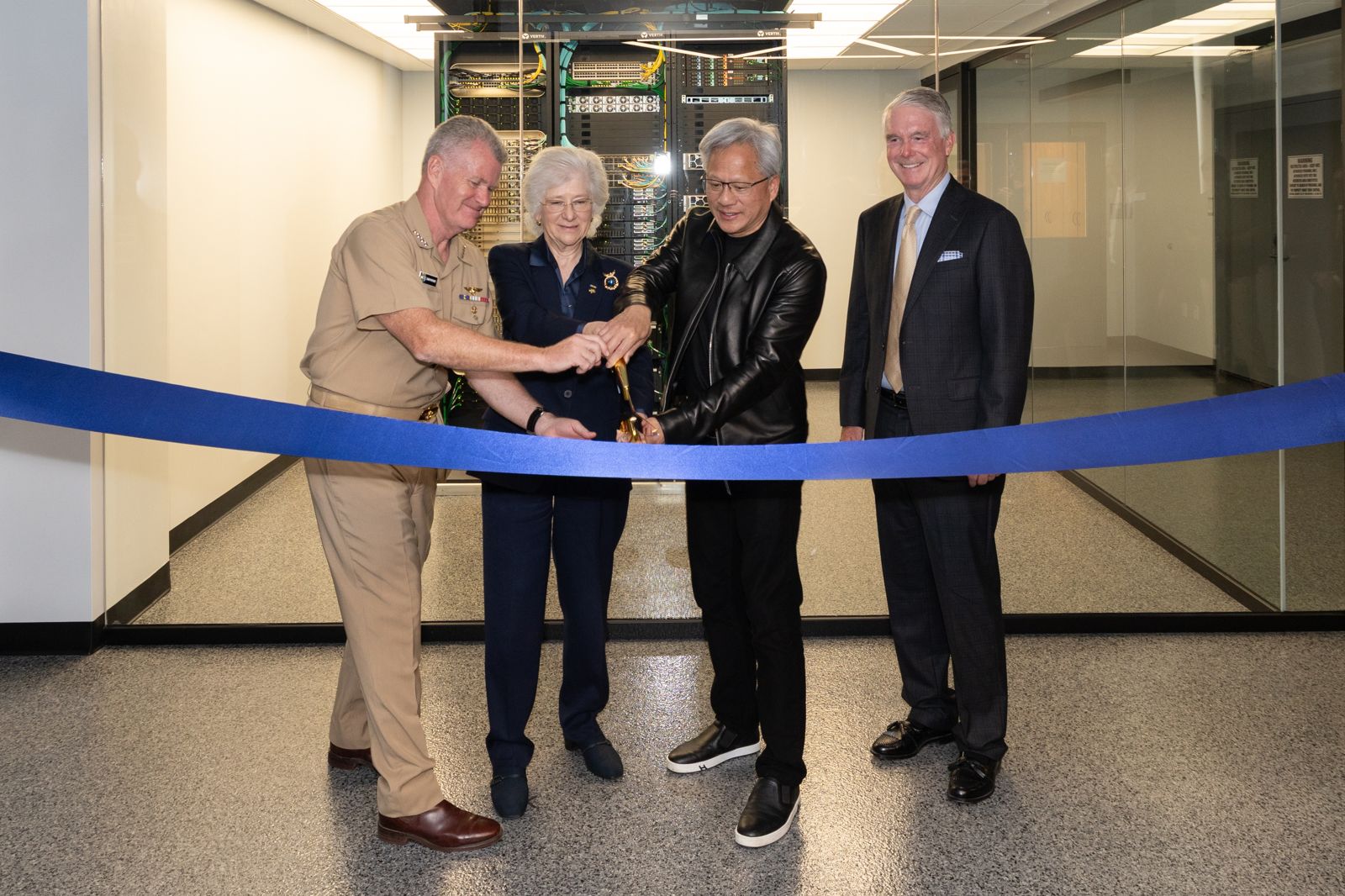
This year, the Naval Postgraduate School Foundation & Alumni Association helped bring new capabilities, resources and partnerships to NPS, supporting the service members, faculty and families who make it extraordinary. From commissioning the first NVIDIA DGX GB300 in the U.S. military to advancing Digital Trident projects, connecting researchers with industry partners and welcoming new families to Monterey, our donors and partners made real progress possible.
Financial figures cover FY2026 (July 1, 2025 to June 30, 2026), when the Foundation invested $10.1 million in programs for NPS. Stories cover calendar year 2026.
Ingersoll Hall · MontereyCutting the ribbon on the first DGX GB300 in the U.S. military.
“
Use this tool to push the boundaries of what is possible. Explore. Experiment. Innovate.
Adm. Samuel J. Paparo Commander, U.S. Pacific Command
// The top five of 2026
What your support made possible
Five accomplishments that defined the year. Open any one to see how it unfolded and the role our donors and partners played.
// Update · Naval Innovation Center
Advancing the Naval Innovation Center at NPS
The Naval Innovation Center (NIC) at NPS continued to move forward in 2026 under the direction of the Secretary of the Navy. Navy leadership, working with NPS and Naval Facilities Engineering Systems Command (NAVFAC), is evaluating the most effective plan, location and delivery approach to meet the Center’s requirements while making efficient use of available resources. This includes exploring a phased approach to establishing initial capabilities and the potential use of Other Transaction Authority (OTA) to provide greater flexibility in project execution.
The NIC will bring together NPS students and faculty, operational leaders and industry partners to accelerate applied research, experimentation, prototyping and the development of capabilities for the Naval and Joint Force.
Throughout 2026, the NPS Foundation supported planning and project development, engaged prospective industry and philanthropic partners, and worked alongside Navy and NPS leadership to advance the Center. As the Navy determines the path forward, the Foundation remains committed to securing the private resources, advanced technologies and partnerships needed to realize the NIC’s vision.
// Why we do this work“
For me, the purpose remains simple: to match the commitment these military student leaders make to our country with the support they deserve.
HP
Hank PlainChair of the Board, Naval Postgraduate School Foundation
// A message from our CEO
Dear Friends,
This has been an extraordinary year for the Naval Postgraduate School, and I’m proud of the part our Foundation and Alumni Association has played in it. Across the institution, students and faculty are tackling difficult problems, developing new technologies and putting their expertise to work in service of our country. Their work deserves our attention and our support, particularly at a time when so much is being asked of our military.
In July, we celebrated a milestone that I believe captures what this community is capable of. NVIDIA founder and CEO Jensen Huang joined NPS President Ann Rondeau, Adm. Samuel Paparo, Commander of U.S. Pacific Command, and Foundation Board Chair Hank Plain to commission the first NVIDIA DGX GB300 system in the U.S. military. In January, the Foundation began transforming an empty room in Ingersoll Hall. Six months later, it housed an extraordinary AI computing capability, made possible through private support, industry partnerships and the hard work of more than 100 people. Within weeks, NPS students and faculty were already putting it to use.
What made that day possible was the same thing that carried us through the rest of the year: people willing to say yes to a good idea and see it through. Through Digital Trident, NPS teams turned AI concepts into working prototypes, and several are now on a path to the fleet, from flight software adopted for an operational drone to a counter-drone system tested alongside our NATO allies. A new round of projects is already taking on challenges in the Pacific. At Converge @ NPS, more than 550 students, researchers, operators and industry partners came together to put ideas in front of the people who can act on them. And alongside NPS leadership and our partners, we continued the work of building the Naval Innovation Center.
Some of our most meaningful work happens outside the classroom and laboratory. We welcomed new students and families to Monterey, supported student clubs and community events, celebrated graduates and strengthened connections with alumni around the world. It all comes back to the people of NPS, and to making sure they feel supported from the day they arrive to long after they graduate.
What stays with me at the end of this year is how much can be accomplished when people care enough to get involved. Our donors, alumni, partners and volunteers have opened doors, shared expertise, committed resources and helped make things happen that would not have been possible otherwise. I have seen that generosity firsthand, and I don’t take it for granted.
We have good reason to be proud of what we’ve accomplished in 2026, and even more reason to keep pushing forward. The men and women serving our nation deserve every advantage we can help provide, and NPS has an important role in preparing them and developing the capabilities they will need.
Thank you for being part of this work and for everything you do for NPS. I look forward to another year together.
Rich Patterson
Chief Executive Officer, Naval Postgraduate School Foundation & Alumni Association
// Highlight reel · YouTube
Watch the day the GB300 came online
NPS President Ann Rondeau commissioned the system on July 22 alongside Adm. Samuel Paparo, commander of U.S. Pacific Command, and NVIDIA founder and CEO Jensen Huang. “The only way to prevail is to out-compete, out-innovate, and out-build,” Paparo told the room.
72NVIDIA Blackwell Ultra GPUs
36NVIDIA Grace CPUs
$1.93MFoundation investment in FY2026
$11.96Mvalue of the GB300 gift
// Empty room to supercomputer · tap a date
// Digital Trident AI Challenge
From first prototype toward the fleet
Digital Trident gives NPS student and faculty teams funding, compute and support to turn an AI idea into a working prototype within a year. Round I teams delivered their results this fall, and Round II is underway.
// Explore every project
17 AI projects across two rounds
// Featured Round I project · Bold Machina
From an operational gap to NATO’s Bold Machina exercise, two years running
Forces in the field needed a way to detect small drones without giving away their own position. CDR Max Leutermann, USN, and Maj. Patrik Liljegard of the Swedish Armed Forces led an NPS team that built a low-cost, passive system to close that gap. Step through the project from the problem to its 2026 field trials.
4 kmdrone detection range at Bold Machina 2025
~1,500 mfull detection chain tested in Sweden, 2026
< 90 minto install on a vessel
2 yearsat NATO’s Bold Machina exercise
// What the Foundation did
Digital Trident Round I funding
Equipment gifts, including ODIN system hardware, a 4K gimbal camera and field kit for Bold Machina 2026
An assistant program manager through a gift of service
Support for field experimentation at JIFX
Showcased the team at Converge @ NPS and Sea-Air-Space
“It gives us the essentials we need to keep pushing: high-end GPUs and ruggedized computing to handle real-time fusion, contracted design help when we hit snags, mounting hardware for BOMA, plus the ability to cover travel, emergent repairs, and field fixes.”Maj. Patrik Liljegard & CDR Max Leutermann, on Digital Trident funding
Digital Trident is one way donors help NPS develop, test and transition new capability. These programs carry that work further, from field testing to the tools and people behind the research.
JIFX · Camp Roberts
Testing new systems in the field
Several times a year, NPS teams test emerging technology alongside companies and operators across 30,000 acres of controlled airspace and spectrum at Camp Roberts. Over four years, JIFX has hosted 307 experiments with 208 organizations. In 2026, Foundation support kept NPS teams in the field, and our Strategic Initiatives Committee helped make the case for funding through 2027.
$216,308 in FY2026Athena
Connecting NPS research with the partners who need it
Developed and operated by the Foundation, Athena is a secure platform that links NPS research with the wider defense innovation network, so sponsors can find projects to partner on and researchers can see related work across institutions.
$1.44M in FY2026AI Task Force
The people guiding AI at NPS
Foundation support provides mentors, research staff and program management for AI education and research across NPS, the team behind its hackathons, fellowships and growing use of the GB300.
$429,878 in FY2026
// In their words
The people your support reaches
Students, faculty, partners and the leaders who champion NPS, on what this work makes possible. Most come from our monthly Faces of NPS interviews.
// Life at NPS · families, community & alumni
Building community at NPS and beyond
Every quarter, students and their families arrive at NPS from across the United States and around the world. Representing the Navy, Marine Corps, Army, Air Force, Space Force, Coast Guard and allied and partner nations, these service members take on demanding academic programs while their families adjust to a new community. The Foundation helps welcome them, build friendships and support networks, and stay connected long after graduation.
Mix & Mingle · every quarter
Welcoming every new class
Every quarter, the Foundation welcomes new students and their families with a Mix & Mingle on campus. New arrivals meet NPS leadership, the spouses’ clubs, family and mental health resources, and the student clubs and programs available to them, alongside activities for children.
The goal is simple: help every new student and family connect quickly with the people and resources that will support them throughout their time at NPS.
Held every quarter as new classes arrive
Open to students, spouses, children, faculty and staff
Children’s activities, food and a warm welcome
“When a family feels supported and connected, it allows a warfighter to focus fully on the mission ahead.”Rich Patterson, CEO, NPS Foundation
International Alumni Symposium · July 20–24, 2026
Welcoming our international alumni home
Alumni from 50 countries returned to Monterey this year, renewing relationships among allied and partner militaries that began in NPS classrooms. Usually held overseas, the symposium brought graduates, many joined by their spouses, back to the campus where they studied to reconnect with classmates and faculty and meet the students and partners gathered for Converge @ NPS the same week.
// What the Foundation provided
The Distinguished Alumni Awards Dinner
A full week of programming for spouses
Evening networking events
Food and beverage, A/V support and travel for key attendees
Administrative support for the symposium
// The spouses’ week · pick a day
// FY2026 investment · July 1, 2025 to June 30, 2026
$10.1 million put to work for NPS
Program spending by the Foundation in FY2026. Add the GB300 gift and the warrior support grants from the America’s Heroes Golf Tournament to see the full picture, then filter by area and pick any line to see what it paid for.
Total shown
$10,064,731
FY2026 program support
Program support reflects FY2026 program expenses. The GB300 in-kind gift and the warrior support grants are shown separately and are not part of program expenses.
// NPS impact · 2026
What NPS achieved this year
Everything the Foundation does serves this work. These are a few of the year’s results from NPS students and faculty, from the Fleet to the space station, and the reason your support matters.
NPS by the numbers · July 2025 – June 2026
4,754student enrollment
1,114graduates
650+funded research projects
~1,300theses, dissertations and capstones
120+active partnership agreements
50+countries represented
Allies & partners · May 2026
Turning battlefield data into intelligence for NATO
NPS students built FASTCAT, a machine learning tool that helps operators identify and track adversary electromagnetic emissions. They prototyped it with battlefield data from Ukraine and delivered it to NATO Supreme Allied Command, where it exceeded expectations.
Why it mattersFaster intelligence analysis and stronger U.S.–NATO interoperability.
Manufacturing & energy · Summer 2026
Spare parts, printed and delivered at sea
During RIMPAC 2026, NPS ran the largest additive manufacturing experiment ever conducted at sea, including the first autonomous surface vessel resupply of 3D-printed parts to operational forces.
Why it mattersShips and Marines can make and receive parts where they are, even in contested waters.
Fleet & Joint Force · April 2026
A faster path to affordable missiles
NPS doctoral graduate Maj. Dillon Pierce and the Office of Naval Research launched the Tactical Missile Innovation Prize Challenge, which drew more than 40 companies. Anduril won and is now in advanced prototype development.
Foundation connection: Maj. Pierce also led a Digital Trident Round I team
Why it mattersNew, faster and more affordable approaches to building tactical missiles.
Fleet & Joint Force · 2026
A low-cost cyber answer to enemy drones
Maj. Christian Thiessen’s research produced the Detachable Drone Hijacker, a drone-mounted cyber payload that defeats adversary drones with precise cyber effects instead of kinetic or high-energy weapons. It has been patented and licensed for commercial development.
Foundation connection: Field-tested at JIFX, which the Foundation supports
Why it mattersAn affordable counter-drone option that can scale.
Space · September 2026
From the classroom to the International Space Station
A team of recent NPS graduates built a terahertz imaging camera that is set to fly to the International Space Station in 2027.
Foundation connection: A Digital Trident Round I project
Why it mattersStudents are building flight hardware for real space missions.
Space · 2026
Laser links that are hard to detect
Space Systems student Capt. Chris Henderson, USMC, developed ways to send satellite data by laser and LED with a low chance of detection or interception, using NPS CubeSats and the school’s global satellite ground network.
Why it mattersMore resilient satellite communications for contested environments.
Manufacturing & energy · 2026
Twice the penetration at a fraction of the cost
LT Sarah Freeman and physics professor Dr. Ray Gamache developed a low-cost, 3D-printed copper warhead liner that penetrated twice as far as a traditionally made liner in testing at Naval Surface Warfare Center Indian Head.
Why it mattersBetter-performing munitions for far less money.
Manufacturing & energy · 2026
Keeping the power on at Navy bases
Tools developed at the NPS Microgrid Innovations Research Center helped Naval Air Station Sigonella design and install a new energy generation and storage microgrid, the first of its kind in Navy Region Europe.
Why it mattersInstallations that can keep operating when the grid is degraded or under attack.
Allies & partners · 2026
Wargaming alongside Japan
NPS students and faculty supported the third North West Pacific wargame with the Japan Maritime Self-Defense Force, U.S. Pacific Fleet and U.S. 7th Fleet in Kanagawa, Japan.
Why it mattersStronger U.S.–Japan readiness, with students gaining real-world wargaming experience.
Fleet & Joint Force · November 2026
Pacific Fleet and NPS make it official
U.S. Pacific Fleet and NPS signed an agreement on Nov. 2 that embeds an NPS fleet liaison officer with the Pacific Fleet staff, linking Fleet priorities with NPS education, faculty expertise and student research.
Why it mattersNPS research stays tied to what the Fleet needs right now.
AI & people · 2026
Marines building AI for their own commands
The first U.S. Marine Corps–NPS AI Fellowship paired Marines with NPS faculty and industry experts to tackle challenges from their own units. The fellowship is now expanding to include Navy participants.
Why it mattersAn AI-ready force that can build and use these tools responsibly.
The Navy is in the middle of a nearly $900 million modernization of the NPS campus, the first major update to buildings that date back to the 1950s. Bullard Hall reopened in 2025 with modern labs, classified space and flexible classrooms. Work on Halligan Hall is underway now, and Spanagel Hall and other buildings will follow into the 2030s.
The Navy is also planning the Naval Innovation Center, where students, faculty, operators and industry partners will build and test new ideas together. The Navy will build it, and the Foundation is bringing in the private support and partners to outfit and sustain it.
For our donors, that commitment matters. The Navy is investing in NPS for the long term, and private support is what helps the people inside those buildings move faster: new technology, industry partners, and care for the students and families at the heart of it all.
2025CompleteBullard Hall
NowUnderwayHalligan Hall
NextPlannedSpanagel Hall & more
2030sGoalA modernized campus
// What’s next
Looking ahead to 2027
This year opened new doors for NPS. Here is where we are taking that momentum next, always starting with the people who make NPS what it is.
Our first priority
Students and families come first
Supporting the people of NPS is at the heart of our work. In the year ahead, we will expand the student programs, clubs, family events and opportunities for connection that help students and their families settle in and thrive during a demanding assignment.
Warm welcomes for every new class and family
Programs and gatherings for spouses and children
20 clubs and community events, free to NPS families
Everyday support from arrival through graduation
Coming in 2027 · Building 260
A place on campus to build and test AI
Building 260, the former campus post office, was slated for demolition. The Foundation is giving it a second life. We are restoring the mid-century building and making it the home of the Artificial Intelligence and Super Intelligence (AI/SI) Test Range, a place inside the fence line where NPS students, faculty and industry partners can test AI at the edge and work on real problems together.
With renovations underway across several campus buildings, NPS needs room for this kind of work now. While planning for the Naval Innovation Center continues, the Foundation is moving quickly to fill that need, and to learn in practice what an AI test range, deeper partner engagement and faster delivery to the fleet can look like.
We expect NVIDIA to be an anchor partner, and the space is designed so more partners can join and work side by side with NPS students and faculty. It complements the Navy-led Naval Innovation Center, giving NPS a place to start this work now.
≈5,200square feetOn campus, steps from classrooms and labs
AI/SI Test RangeCompute and room to test AI at the edge
Open collaboration bayStudents, faculty and partners working together
Offices & small meeting spacesPlaces to plan, meet and get work done
Partner & event spaceWhere industry partners can join the work
// Also on the horizon
Digital Trident II
Ten teams, Pacific challenges
Over the next year, ten NPS teams will take their projects from proposal to prototype, and we will share their progress along the way.
Converge @ NPS · January & July
Two gatherings, more partners
A focused January event with longtime partners, followed by a larger summer gathering that welcomes new ones.
GB300 in use
Expanding access to AI computing
Students and faculty are already running hackathons on the system, from cyber defense to supply chain security, with more to come.
Naval Innovation Center
Outfitting what the Navy builds
We will keep securing the private support and partners that will help outfit and sustain the Navy-led Naval Innovation Center.
// Get involved
Help make what’s next possible
Your support helps the Foundation provide the resources, technology, partnerships and programs that strengthen NPS and its community. From advancing research and new capabilities to supporting the service members and families who call NPS home, every gift supports the people and work that help keep our nation safe.
By checkPayable to Naval Postgraduate School Foundation · P.O. Box 2316, Monterey, CA 93942
By phone831-656-2339
QuestionsCarly Olson, Director of Development · colson@npsfoundation.org
// Ways to give
Give in the way that works for you
For gifts beyond a donation online, contact Carly Olson, Director of Development, at colson@npsfoundation.org or 831-656-2339. She can help with instructions and paperwork.
Make a donationGive online, by check or by phone. Gifts can be unrestricted or directed to a program you care about. Give online →
Give in honor of someoneMake a gift in memory or in honor of someone special to you.
Planned givingInclude the Foundation in your will or living trust, name it as a beneficiary of a retirement plan or life insurance policy, or set up a charitable gift annuity or remainder trust that pays you income for life. Learn more →
Matching giftsMany employers match charitable gifts, and spouses, retirees and surviving spouses often qualify. Ask your HR team about a matching program.
Stock and wire transfersTransfer appreciated securities directly from your broker, or send a gift by wire. Contact Carly for transfer instructions.
The Naval Postgraduate School Foundation is a 501(c)(3) nonprofit. Tax ID 23-7098729. Gifts are tax-deductible to the extent allowed by law.